
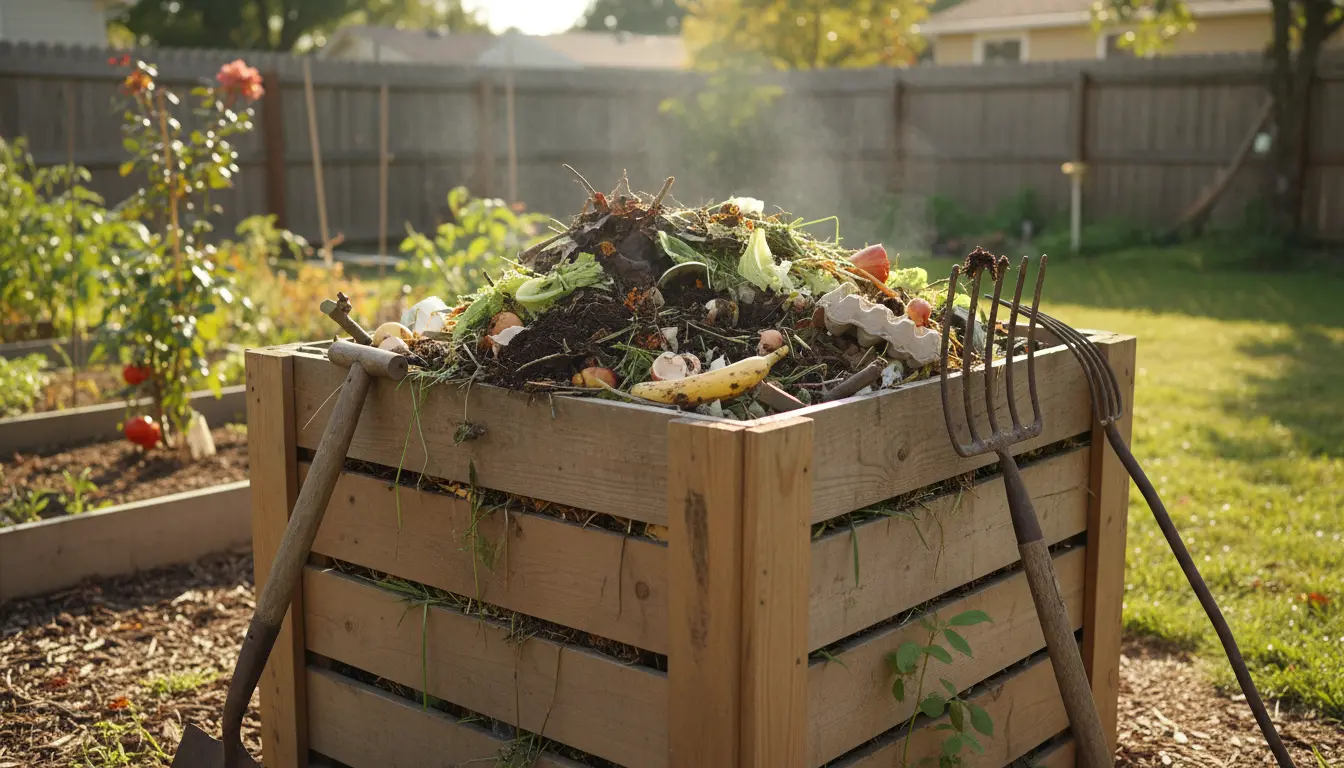
Why Home Composting Matters
Home composting turns kitchen and yard waste into nutrient-rich soil. It reduces household trash, lowers methane emissions from landfills, and supports healthy gardens.
For beginners, composting is a practical way to close the loop on organic waste and improve soil structure without chemical additives.
How to Start Composting at Home
Starting composting at home is a few straightforward steps: select a bin, add the right mix of materials, maintain balance, and monitor moisture and temperature. You do not need special tools or a large yard to begin.
Follow this step-by-step plan to establish a working compost system in weeks rather than months.
Choosing a Compost Bin for Home Composting
Select a bin based on available space and how much organic waste you generate. Options include tumblers, stationary bins, and simple open piles for larger yards.
- Tumbler: Fast mixing, good aeration, ideal for small yards or patios.
- Stationary bin: Low effort, stable temperature, works for most homeowners.
- Open pile: Best for large properties, minimal cost, requires more attention to pests and wet weather.
What to Compost at Home
Successful home composting depends on a balance between brown (carbon) and green (nitrogen) materials. Aim roughly for a 3:1 ratio of browns to greens by volume.
- Greens: Fruit and vegetable scraps, coffee grounds, fresh grass clippings.
- Browns: Dry leaves, straw, shredded paper, cardboard without glossy coatings.
- Avoid: Meat, dairy, oils, diseased plants, and pet waste to reduce odors and pests.
Layering and Turning for Composting at Home
Start with a layer of coarse browns for drainage, then alternate greens and browns in 2–4 inch layers. Keep the pile moist like a wrung-out sponge.
Turning aerates the pile and speeds decomposition. For a hot, fast compost, turn every 1–2 weeks. For low-maintenance systems, turn monthly or let nature take its course.
Troubleshooting Common Problems in Home Composting
Even simple compost systems can encounter issues. Troubleshooting focuses on three variables: moisture, air, and particle size.
- Bad smells: Usually from excess greens and low oxygen. Add browns and turn the pile.
- Too dry: Add water and more greens; mix to distribute moisture.
- Slow decomposition: Chop materials smaller, increase greens, or raise temperature by adding more mass.
Pest Control When Composting at Home
To discourage rats and flies, avoid adding meat and dairy and bury food scraps under a layer of browns. Use sealed tumblers or bins with fine mesh at the base if rodents are common in your area.
Cold-climate users can insulate bins or add more volume to retain heat during winter months.
How to Use Finished Compost from Home Composting
Finished compost is dark, crumbly, and earthy-smelling. Use it as mulch, blend it into potting mixes, or top-dress vegetable beds.
A typical application rate is 1–2 inches of compost as mulch or mixing 10–20% compost into garden soil when planting.
Household composting can reduce your garbage output by up to 30 percent, depending on your diet and yard waste. This also lowers greenhouse gas emissions from landfills.
Simple Case Study: A Small Kitchen, Big Impact
Mary, a renter with a small balcony, started composting in a 40-liter tumbler. She collected vegetable peelings and coffee grounds in a countertop caddy and emptied them into the tumbler twice a week.
Within six months she had enough compost to feed three potted herbs and a container of tomatoes. Her weekly trash volume dropped noticeably, and her plants grew stronger with the homemade amendment.
Practical Tips for Consistent Home Composting
- Keep a small kitchen caddy near your prep area to make collecting scraps easy.
- Chop or shred larger items to speed breakdown.
- Maintain the moisture level; too dry slows decomposition and too wet causes odors.
- Record additions and turn schedule to learn what mix works for your climate.
Final Checklist for Starting Composting at Home
- Choose the right bin for your space and pest risk.
- Gather a mix of browns and greens and maintain a rough 3:1 ratio.
- Monitor moisture, aeration, and particle size.
- Use finished compost to enrich soil and reduce the need for chemical fertilizers.
Home composting is accessible to nearly every household and can be scaled to fit small apartments or large gardens. With a little practice and observation, you can turn everyday organic waste into a valuable resource for your plants.